
Will the four axioms of thought revolutionise teaching?
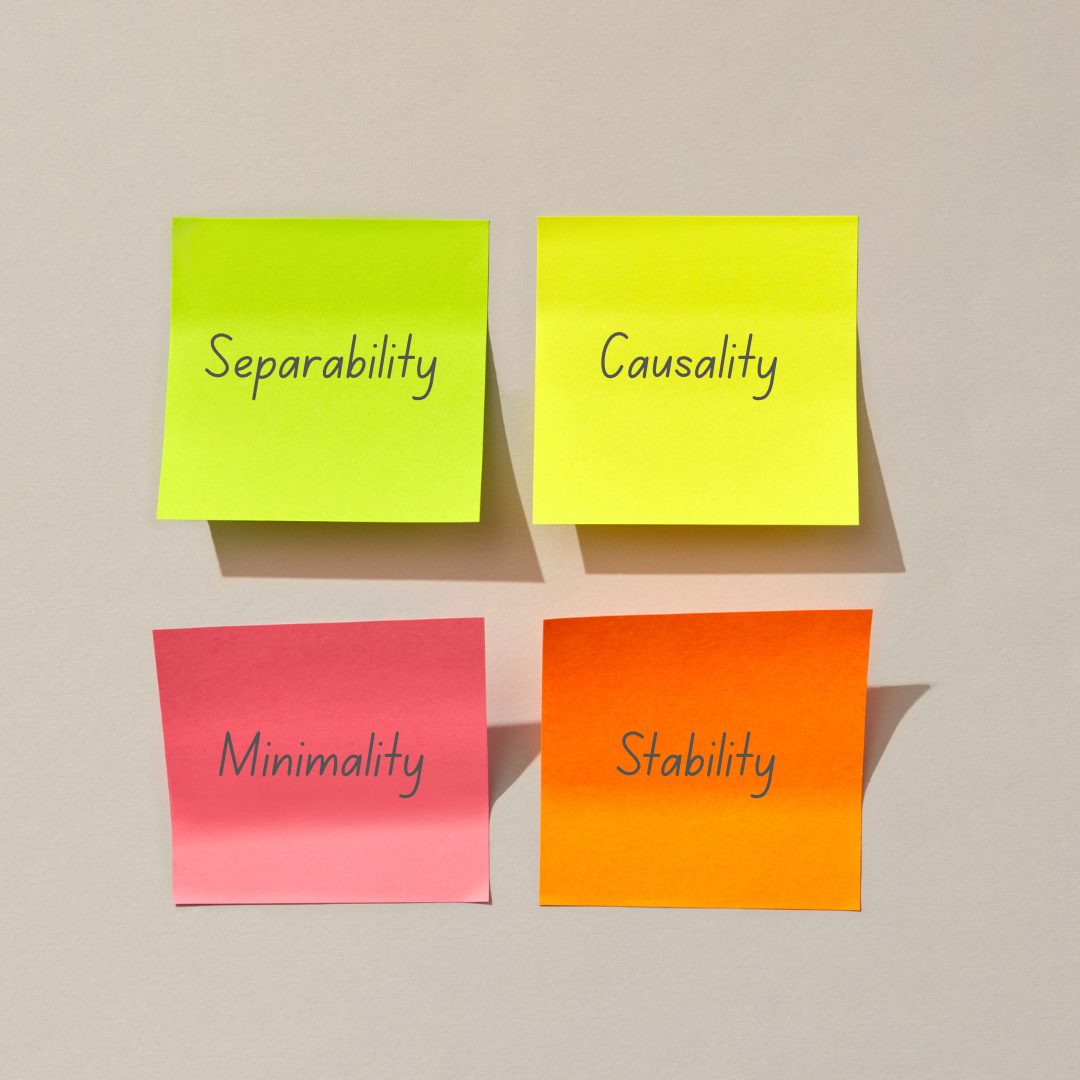
The vast amounts of money in AI research have led to advances in understanding of disability particularly education. A recent paper has disrupted the field, it describes way of thinking how using poor methods can damage a person's ability to problem solve. The extraordinary simplicity of their insight is hidden by the technical heading and the dense wording. This article explains why their paper will transform the way we think about education, workforce training and cognitive disability.
The paper is "Formalizing Latent Thoughts: Four Axioms of Thought Representation in LLMs," by researchers Fahd Seddik and Fatemeh Fard. The paper looks at the way that LLM thinks about a problem by looking at the internal thought patterns. In the paper they use the terms ‘latent thought representation’ and ‘intermediate thinking’ to describe continuous vector spaces. The takeaway is that both LLMs and humans have ‘intermediate thinking’ as a way of working out complex problems in their heads.
So far, not too surprising, however Seddik and Fard then do something very clever, they classify the intermediate thinking into four axioms or rules. For a disability analyst, these axioms are a revelation as these rules could help people learn better or train AI more effectively. They are a how-to fix for disabilities in problem solving and are both extraordinarily simple and powerful. To understand the significance of this discovery, think of the following example. A person who gets mixed up when asked to do invoices can be shown where and why their internal processing is derailing.
1. Break the Puzzle into Parts (Separability)
In the real-world things are messier and more complicated than in structured examinations. The rote techniques that allowed the LLM/student to get good marks at school are much less effective in a dynamic work situation. They have both learned how to provide solutions to known format but not break down novel puzzles into modular parts.
The Separability axiom states that complex puzzles need to be separated into parts to be solvable. Chain-of-Thought (CoT) has improved performance but Seddik and Fard have found that all current models still struggle to separate the parts internally within their hidden layers. LLMs still try to find a blurry mathematical representation to the whole puzzle rather than each of the parts.
As a disability analyst this is a common problem even in highly qualified professionals. At a certain level of complexity they often struggle to recognise the parts and they get stuck. Yet, when the puzzle is broken down into parts they have no problem with finding the solutions. This paradox may explain why LLMs give up or hallucinate when a problem exceeds a threshold of difficulty.
2. Choosing Methods (Causality)
Both LLMs and humans often have no problem identifying the right method to deal with a familiar part of a puzzle. This ‘muscle memory’ means that they can recognise the same part even if it is presented in a different way. There are times when they choose the same method when it is not appropriate. More interesting is the phenomenon that sometimes they will not choose a method that they know even when it is appropriate.
Seddik and Fard suggest that the reason is a structural collapse in the intermediate thinking. They see the collapse as being due to both failure to separate details and becoming distracted. Logically however it is possible that a flawed understanding of the method is the problem. Using the method incorrectly would have a similar effect as choosing the wrong method. This may better explain poor performance as having two causes, using the wrong method and using the right method incorrectly.
Training or teaching could differentiate between execution and selection errors and provide appropriate assistance. The best problem solvers try out several models to see which fit and look up the model if their memory is not clear. This process of dynamically checking that the method is right and that it is used correctly is more efficient than brute force memorisation.
3. Avoiding Distraction (Minimality)
A substantial problem in administration is that the real world environments are much more complex than training environments. The LLMs and humans learn to apply their learning effectively in training but struggle to apply their skills in the wild. The real world performance of LLMs does not improve with experience and many companies are having to reverse downsizing.
Seddik and Fard have identified a key cause of this problem, LLMs are easily distracted by irrelevant information. In disability practice filtering out cognitive "noise" is an everyday battle for those with ADHD. This parallel is further strengthened by the observation that LLMs and those with ADHD both have superior memories. Forgetting has long been recognised as a foundation of intelligence and may be part of grokking.
An alternative approach is to increase the value or salience that the person (or AI) puts on bits of information. A person that is guided to see the important parts of the question experiences reduced distraction. LLMs could be trained to assess the value of information and filter things that are of low importance. Humans often read the problem through several times to decide whether a bit of information is relevant or not.
4. Generalisation (Stability)
The pattern of ‘intermediate thinking’ from the first three (separating the problem into parts, finding the right method, ignoring distractions) will impact the stability of the output. LLMs and people who come out with different answers for similar problems lack stability. Unreliable and erratic answers are often more problematic than worse performance because the failures can be unpredictable.
Both LLMs and people can struggle to generalise their knowledge across unfamiliar situations but in opposite ways. An LLMs will learn the correct method from context and humans will not recognise that the method is appropriate. Humans are less context dependent and will be surprised when the LLM gives an unusual answer. This type of brittle intelligence is alien to humans which makes it more difficult to adapt to AI errors.
Teaching humans to generalise traditionally involves overwhelming the human memory with similar examples. The research suggests that overfitting rather than grokking (deep structural comprehension) continues to be a significant problem for the LLMs. Although brute force training is likely to be effective it is also very costly with training times often 10x as long. A different approach may be worth trying, training the LLM to recognise different versions of the same thing.
Conclusions
These four axioms are not entirely novel and there is significant functional overlap between them. Seddik and Fard’s true breakthrough is that they represent a unified mathematical diagnostic framework for thinking. The best teachers will recognise the axioms and are likely to use them intuitively. The paper is transformative because it provides a meta understanding of cognition. Both human and AI training has a mathematical solution to poor problem solving.
Seddik and Fard have audited LLMs against these four axioms and found that the LLMs have impairments in problem solving. LLMs appear to see each prompt as a single entity rather than a series of modular parts that can be individually recognised. They approach problems by using multiple methods in a random fashion with wasted effort. They become overloaded with elements of the prompt often distracted by irrelevant details. They recognise from surface level memory rather than building an internal representation of the problem.
Further study on intermediate thinking such comparing problems with minimality in ADHD and LLMs will likely help develop our understanding. For instance, vectors and brain columns have few similarities however they both describe information processing. Seddik and Fard’s work open the door to an extraordinary new area of understanding but require ongoing investment to develop the technology in education, workforce training and cognitive disability.
By Doctor Mark Burgin, BM BCh (oxon) MRCGP
Dr Mark Burgin graduated from Oxford University in 1987 and studied with The Open University on two occasions in the 1990s. He has also studied for the CPE (law), Medical Ethics, learned Portuguese by living in Brazil. He has written many articles and written books on Personal Injury and the LLMS (your PGCME) and has published Disability Analysis: A Practical Guide and Psychological Keys: Unlocking the Mind’s Mechanisms.
July 2026
Would you like to contribute an article towards our Professional Knowledge Bank? Find out more.

Stay in touch


Explore

Undergraduate
Postgraduate
Policy
-
Follow us on Social media
-


